Ideal Op-Amp Circuit Problem
Find the value of R if the AC Gain (Vout / Vin) = 8.
📘 Question
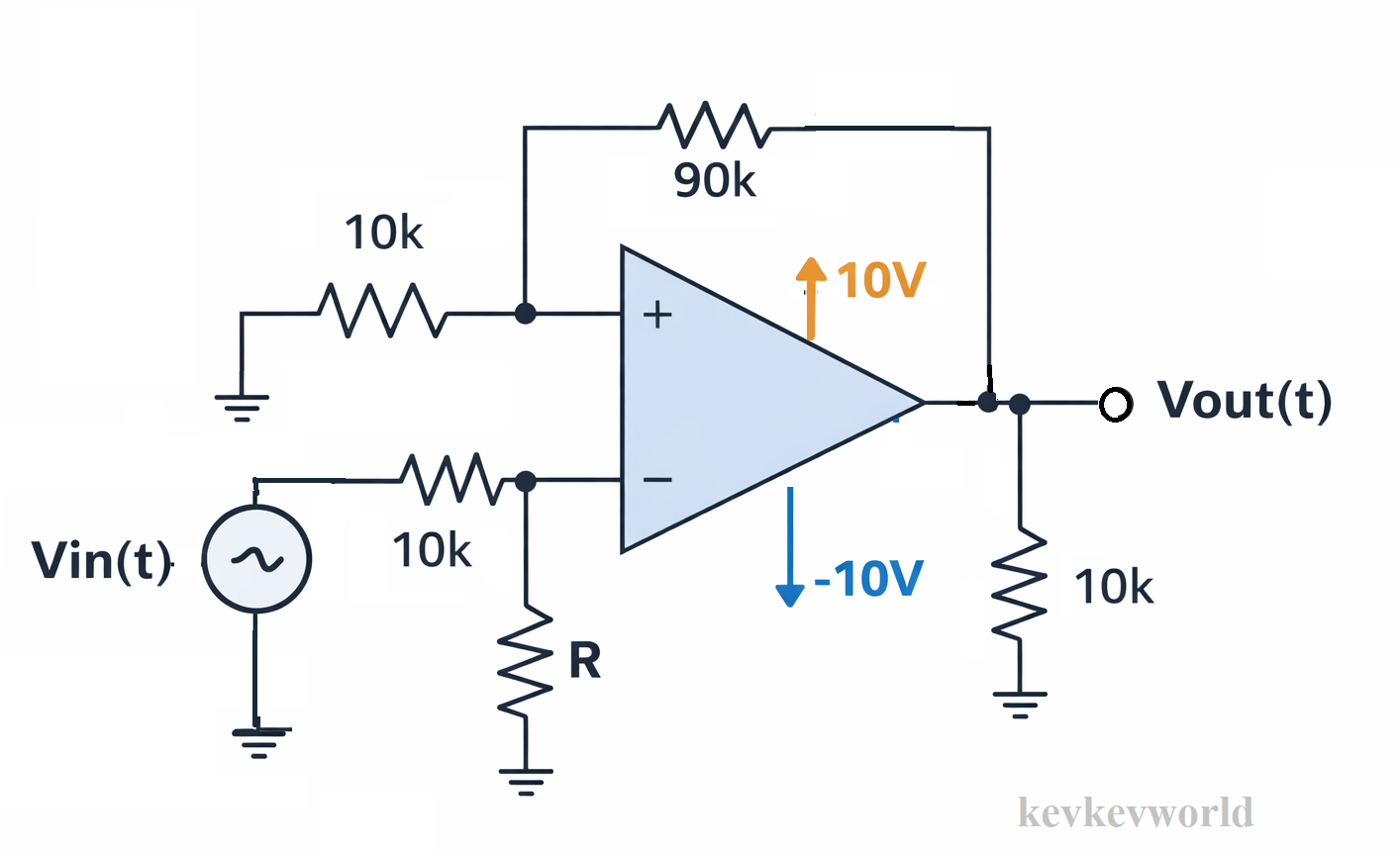
Given an ideal operational amplifier, determine the resistor value R that produces a voltage gain of 8.
Step 1 — Ideal Op-Amp Rule
For an ideal op-amp operating with negative feedback:
- No current flows into the input terminals
- The voltages at the inputs are equal
👉 V⁺ = V⁻
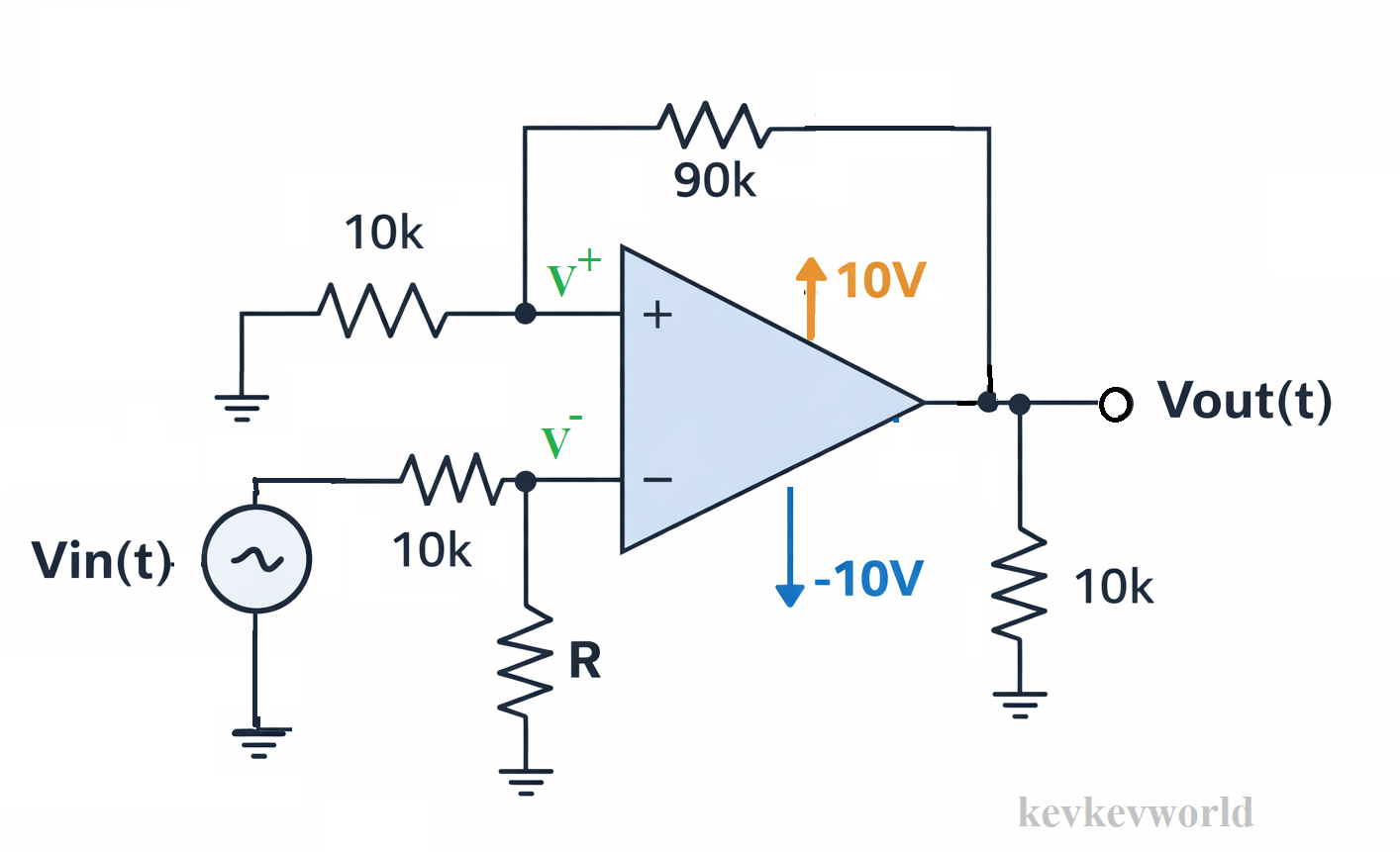
This condition is often called the virtual short.
Even though the terminals are not physically connected, their voltages are identical.
Step 2 — Find V⁺ (Non-Inverting Input)
The positive input is connected to a voltage divider formed by:
- 90kΩ from Vout
- 10kΩ to ground
V⁺ = Vout × (10k / (90k + 10k))
V⁺ = 0.1 Vout
Since V⁺ = V⁻:
V⁻ = 0.1 Vout
Step 3 — Analyze the Inverting Node
The negative input is another voltage divider:
- 10kΩ from Vin
- R to ground
V⁻ = Vin × (R / (R + 10k))
Step 4 — Substitute the Gain
Given:
Gain = Vout / Vin = 8
Vout = 8Vin
Substitute into V⁻:
V⁻ = 0.1(8Vin)
V⁻ = 0.8Vin
Now set both expressions for V⁻ equal:
Vin × (R / (R + 10k)) = 0.8VinCancel Vin:
R / (R + 10k) = 0.8
Step 5 — Solve for R
R = 0.8(R + 10k)

R = 0.8R + 8k

0.2R = 8k

R = 40kΩ
✅ Final Answer: R = 40 kΩ
⚡ Engineering Insight
Many students notice the 10kΩ resistor at the output and wonder if it affects the gain.
It does NOT.
An ideal op-amp has zero output resistance, meaning it can drive loads without changing the output voltage.